
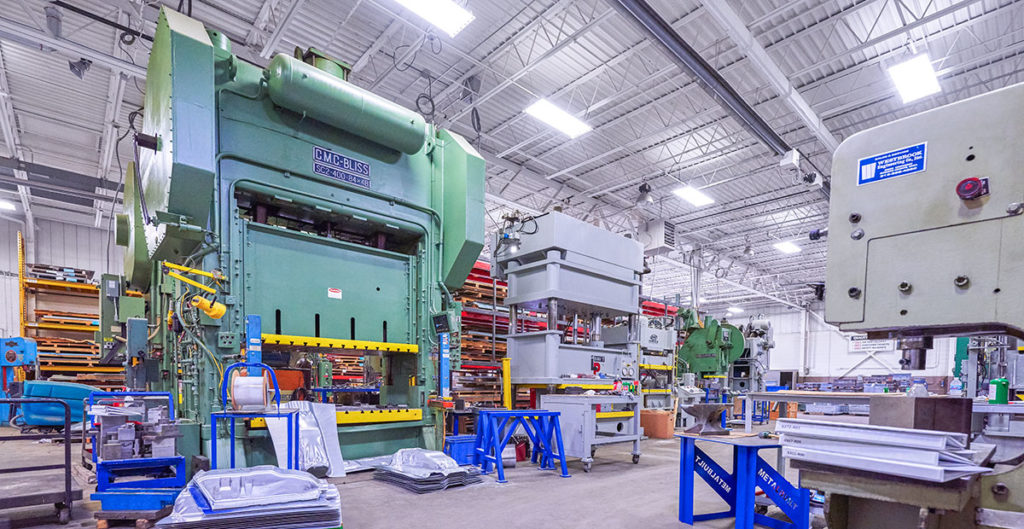
Metalbuilt was founded in 2007 to bridge the gap between their customers’ engineering concepts and sellable products, through vertically integrated manufacturing of metal components from prototype to low volume production. Those processes include designing and machining soft and hard stamping tooling and fixtures, forming or machining parts, laser-cutting blanks or features, MIG or spot welding assemblies, and managing outside processes such as heat-treating, painting, and coatings to ship a ready-to-use component. Metalbuilt has earned industry certifications of ISO 9001, IATF 16949, AS9100 and NIST 800-171, and is a certified woman-owned business.
Challenges
The change in the cadence of the North American automotive industry development of new vehicles in combination with the shift in vehicle propulsion technology led to changing demand for Metalbuilt’s capabilities starting in 2023, with a similar outlook for 2024. This necessitated the company to adapt in its pursuit of new markets and new customers.
EGI’s Solution
Through the Economic Growth Institute (EGI) at the University of Michigan, Metalbuilt received funding support and hands-on assistance. EGI took a multi-faceted approach to ensure the project’s success by:
- Assessing the various business needs, personnel, and manufacturing capabilities to build a plan and set priorities
- Vetting and matching Metalbuilt with a qualified consultant experienced in both business and operational consulting with a focus on reducing costs and improving revenues
- Coordinating the project to ensure timely and appropriate progress
With EGI and the consultant, Metalbuilt established focused KPI’s on market expansion and business acquisition activities, simultaneously taking steps to lower costs of purchased materials and outside services and improving labor productivity. EGI support allowed Metalbuilt to focus on lowering costs while pursuing new customers and new markets to achieve their performance and financial objectives.
Results
Metalbuilt has successfully lowered their cost structure by nearly 25%, thereby improving their market competitiveness. In parallel the company has experienced strong growth as a result of the more competitive cost structure and a focus on new markets including defense and commercial vehicles.